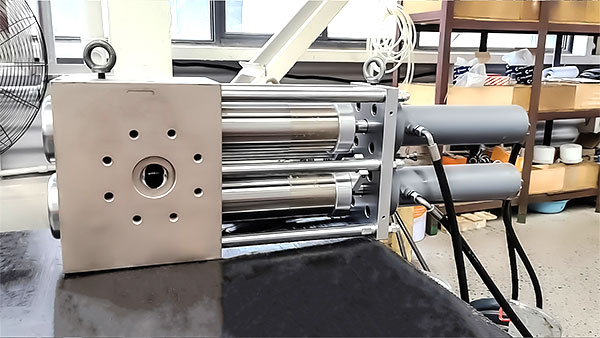
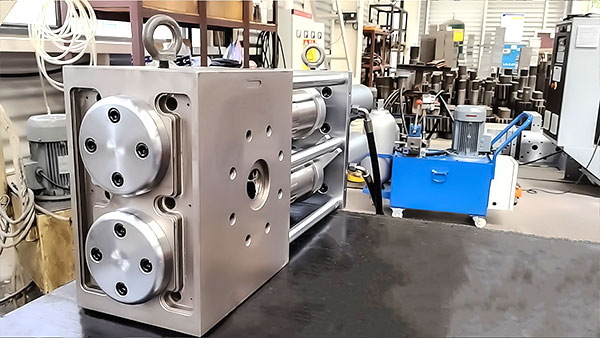
The dual-column screen changer serves as the core equipment for continuous, non-stop screen changing. Within film extrusion production lines, it plays a crucial role in filtering melt impurities, stabilizing melt pressure, and ensuring film forming quality. It is particularly well-suited for large-scale production scenarios involving various films such as BOPP, BOPET, CPP, PE, and PVC.
Core Application Value
Non-stop Screen Changing for Enhanced Production Efficiency
Film extrusion lines demand high continuity. Shutdowns for screen changes lead to material waste, increased roll splices, and time-consuming restart adjustments. The dual-column screen changer employs hydraulic drive for dual-station switching. While one station filters, the other undergoes offline cleaning/replacement. The switch takes mere seconds, enabling 24/7 continuous production while drastically reducing downtime losses and labor costs.
Precise Impurity Filtration Ensures Film Quality
Film products demand stringent surface smoothness and thickness uniformity. Contaminants like carbonized particles, metal shavings, and impurities in raw materials cause defects such as holes, crystalline spots, and streaks. The dual-column screen changer, equipped with high-precision screens (typically 40-200 mesh), efficiently traps minute impurities in the melt. This ensures melt cleanliness, enhancing film transparency, tensile strength, and surface flatness to meet quality demands in high-end applications like food packaging films and optical films.
Stabilizing Melt Pressure to Optimize Extrusion Process
During film extrusion, melt pressure fluctuations directly cause thickness deviations. The dual-station symmetrical structure and constant-pressure control design of the dual-column screen changer maintain stable melt pressure during screen changes, preventing thickness variations caused by pressure surges. Simultaneously, stable pressure reduces extruder screw load, minimizes material degradation risks, and enhances process stability in film production.
Suitable Film Extrusion Line Types
Biaxially Oriented Polypropylene/Polyethylene (BOPP/BOPET) Film Production Lines
This represents the core application scenario for dual-column screen changers. BOPP/BOPET film production involves high temperatures (200-300°C), high melt viscosity, and stringent requirements for continuous operation. The dual-column screen changer must withstand high temperatures and pressures (typically operating at 15-35 MPa), serving as the melt filtration link between the extruder and the longitudinal stretching machine (MDO) to prevent film breakage during stretching.
Cast Film Production Lines (CPP/CPE)
Cast film production operates at high speeds (up to 300m/min or more). Twin-column screen changers effectively filter impurities from raw materials, preventing bright spots and defects on the cast film surface. Simultaneously, stable melt pressure ensures uniform film thickness, enhancing the film's heat-sealing properties and transparency.
Blown Film Production Line (PE/PVC)
In blown film production, the dual-column screen changer resolves issues caused by high recycled material ratios, reducing impurities through efficient filtration. This lowers bubble rupture rates and increases blown film yield, making it particularly suitable for large-scale production of packaging PE film and agricultural PVC film.
Key Technical Selection Criteria
Filter Screen Specification Matching
High-end optical films, food packaging films: Select multi-layer composite screens (e.g., 80+120+80 mesh) to balance filtration precision and flow capacity;
General packaging films, recycled material production: Choose 40-80 mesh screens to reduce clogging frequency and minimize screen changes.
Drive and Sealing System
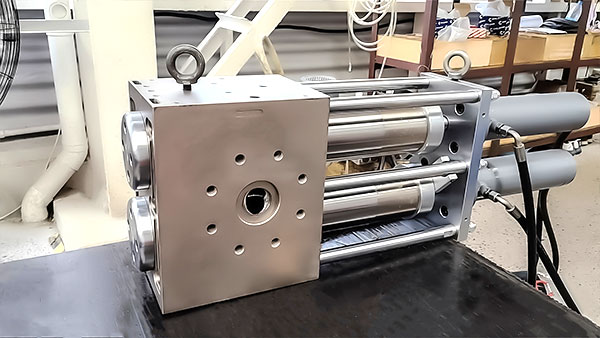
Prioritize hydraulic-driven dual-column screen changers for rapid switching, stable pressure, and compatibility with high-speed film lines;
Seals must use high-temperature-resistant fluororubber or metal seals to prevent hot melt leakage and eliminate production safety hazards.
Compatibility with Extruders
Select screen changers with melt flow channel diameters matching the extruder screw diameter (e.g., Φ90, Φ120, Φ150mm) to ensure proper melt flow velocity. Avoid pressure loss from oversized channels or melt degradation from restricted flow due to undersized channels.
Email: sale@meltpump.com
WhatsApp: +86 158 3833 1071


 TEL:+86 371 67991755
 WhatsApp: +86 158 38331071
 Adress: No.22 Dongqing Str., High & New Technology Development Zone, Zhengzhou, China.
