The PP sheet melt extrusion pump is a high-temperature, high-viscosity melt conveying and metering device specifically designed for continuous polypropylene (PP) sheet extrusion production lines. Its core functions include pressurizing and stabilizing the melt, as well as precisely controlling flow rate, ensuring uniform sheet thickness and a smooth surface, thereby significantly improving product yield and production efficiency.
This equipment is typically installed between the extruder outlet and the die head. As a key component of a “functional separation” design, it transfers the pressure-building task—originally performed by the extruder—to the melt pump, allowing the extruder to focus solely on plasticization and mixing. Consequently, the extruder can operate at lower back pressure, reducing energy consumption by 10%–30%.
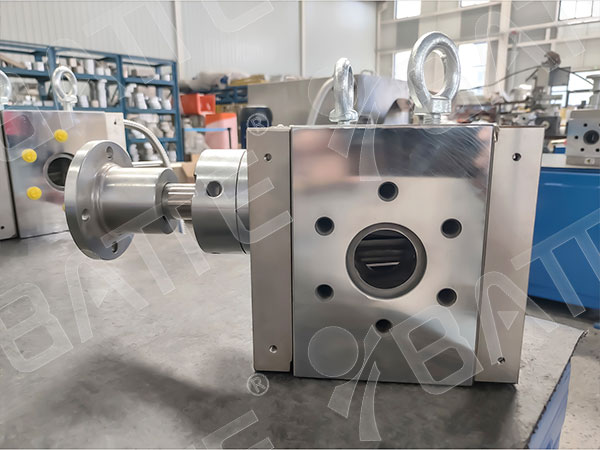
Core Structural Components
Pump Body and Flow Channel System: Constructed from nitrided 38CrMoAlA alloy steel, the inner walls are smooth and wear-resistant, suitable for PP melt operating pressures of 15–25 MPa; the flow channels feature a streamlined design to minimize stagnation and pressure loss.
High-Precision Gear Assembly: A pair of hard-tooth-surface ground gears with a tooth-to-tooth clearance controlled between 0.01–0.03 mm ensures stable positive displacement delivery, guaranteeing a flow rate accuracy error of <±0.5%.
Drive and Sealing System: Equipped with a variable-frequency gear motor, supporting stepless speed adjustment to match extrusion volume; features double-face mechanical seals with high-temperature sealant cooling, withstanding temperatures of 200–250°C to prevent leakage.
Monitoring and Control System: Pressure sensors are installed at the inlet and outlet, providing real-time data feedback to the PLC system to enable dynamic adjustment and eliminate pressure fluctuations.
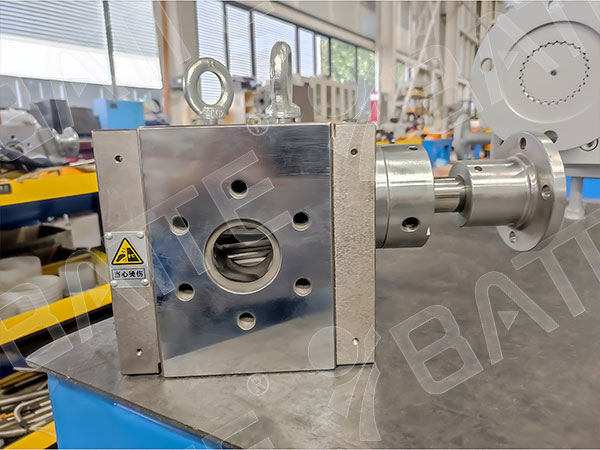
Key Advantages
Enhanced Product Precision: Stable output with pressure fluctuations <±0.5 MPa, allowing sheet thickness tolerances to be controlled within ±0.02 mm.
Increased Output and Efficiency: Extrusion output per unit time increases by 15%–25%, while scrap rates decrease by over 30%.
Energy Savings and Reduced Consumption: The extruder can operate at low pressure and low temperature, reducing main motor energy consumption by 10%–30%.
Extended Equipment Lifespan: Reduces the load on the screw and thrust bearings, extending the service life of the extrusion system by more than 2 years.
Email: sale@meltpump.com
WhatsApp: +86 158 3833 1071
pre:The Key Role and Application Advantages of Melt Pumps in Cast Film Production Lines


 TEL:+86 371 67991755
 WhatsApp: +86 158 38331071
 Adress: No.22 Dongqing Str., High & New Technology Development Zone, Zhengzhou, China.
