In silicone tube extrusion production lines, melt pumps serve as both precision pressure stabilizers and guardians of constant flow. Leveraging core advantages such as stable pressure delivery, precise metering, and melt homogenization, they significantly enhance the dimensional accuracy, surface finish, and overall production efficiency of silicone tubes. As a result, they are essential standard equipment for the mass production of high-end silicone tubes and medical-grade silicone catheters.
Silicone raw materials are generally characterized by high viscosity, high thermal sensitivity, and shear sensitivity. Traditional single-screw extrusion processes are susceptible to fluctuations in feed rate, temperature drift, and backpressure changes, leading to pressure pulsations. This results in issues such as uneven wall thickness, eccentricity, rippling, poor surface finish, and high scrap rates in the extruded tubing. Installing a melt pump addresses these common challenges in silicone extrusion at the source, enabling stable production, high-quality products, energy savings, and improved efficiency.
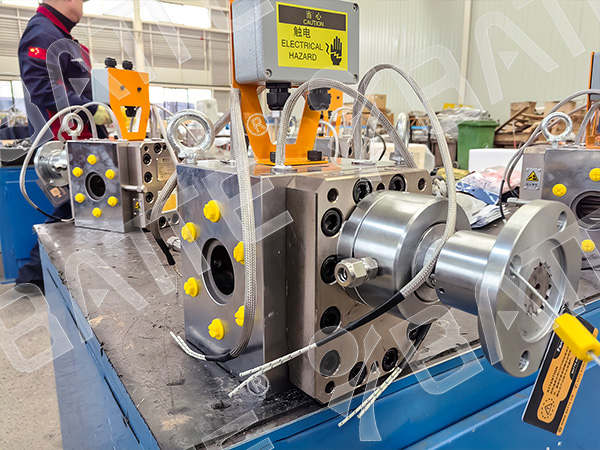
The Key Role of Melt Pumps in Silicone Tube Extrusion
1. Isolating Pressure Fluctuations and Stabilizing Melt Pressure for Smoother Extrusion
The melt pump features a positive-displacement, forced-feed design that isolates pressure fluctuations from the extruder upstream of the pump, delivering a stable and continuous flow of silicone melt to the die. Outlet pressure fluctuations can be controlled within **±1%**, effectively eliminating pulsation, striations, and thickness variations. This results in improved product concentricity and higher batch consistency.
2. Precise metering to lock flow rates and strictly control dimensional deviations
The melt pump’s output flow rate is linearly proportional to its rotational speed; adjusting the pump speed allows for precise control of the extrusion volume, enabling closed-loop online control of wall thickness. Compared to traditional extrusion methods, the wall thickness deviation of silicone tubing has been optimized from **±5% to ±8% to ±1%**, resulting in a significant improvement in yield and material utilization rates. This process is ideal for the production of thin-walled, high-precision, medical-grade silicone tubing.
3. Secondary homogenization of the melt to enhance transparency and mechanical strength
During the forced conveyance via gear meshing, the silicone melt undergoes further dispersion, homogenization, and degassing to eliminate bubbles. This reduces crystal spots, air bubbles, and agglomerated impurities, resulting in products with better light transmission, smoother inner walls, and superior tensile and pressure resistance. These products meet the stringent requirements of high-barrier applications such as medical, food, and water purification industries.
4. Reduced Load and Stress, Extending the Service Life of the Extruder
With the addition of a pump, pressure generation is handled by the pump, allowing the extruder to focus on plasticizing and mixing. As the main unit operates at low pressure over extended periods, wear on the screw and barrel is minimized, and the load is reduced. This extends the major overhaul cycle to 1.5 to 2 times the original duration, resulting in lower overall operating and maintenance costs.
5. Excellent High-Temperature and High-Viscosity Performance, Suitable for Demanding Silicone Applications
The entire machine is constructed from high-temperature-resistant, wear-resistant, and corrosion-resistant materials, capable of withstanding operating conditions up to **400°C**. It is suitable for the continuous extrusion of high-temperature, high-viscosity, filled, and modified silicone materials, ensuring stable operation, minimal downtime, and excellent continuity.
6. Reduce Energy Consumption, Increase Line Speed, and Maximize Production Capacity Benefits
Following the optimization of process division, the overall energy consumption of the entire line has decreased by 15% to 20%. At the same time, the maximum extrusion speed has increased by more than 30%, making the line more suitable for applications involving powder addition, color matching, and silicone compounding. The longer it runs, the more energy-efficient and faster it becomes.
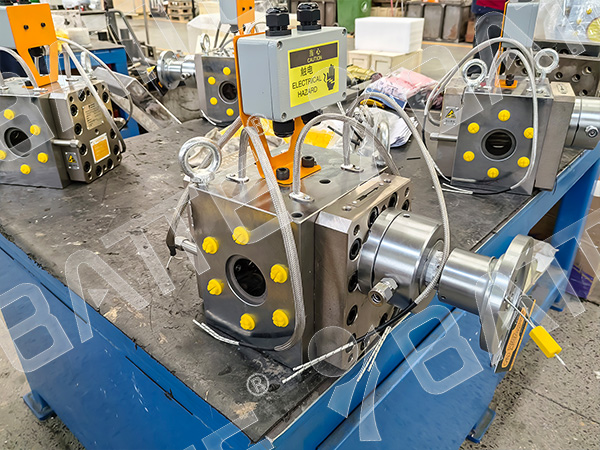
Melt pumps isolate pressure fluctuations during silicone tube extrusion, ensuring stable delivery of melt with ±1% precision. They optimize wall thickness deviation to ±1%, thereby improving yield rates while reducing energy consumption by 15% to 20% and extending equipment lifespan by 1.5 to 2 times. As such, they are essential for the mass production of high-end silicone tubes.
Email: sale@meltpump.com
WhatsApp: +86 158 3833 1071
pre:The Differences Between Melt Pumps, Melt Gear Pumps, and Gear Pumps
next: Reactor kettle melt pump


 TEL:+86 371 67991755
 WhatsApp: +86 158 38331071
 Adress: No.22 Dongqing Str., High & New Technology Development Zone, Zhengzhou, China.
