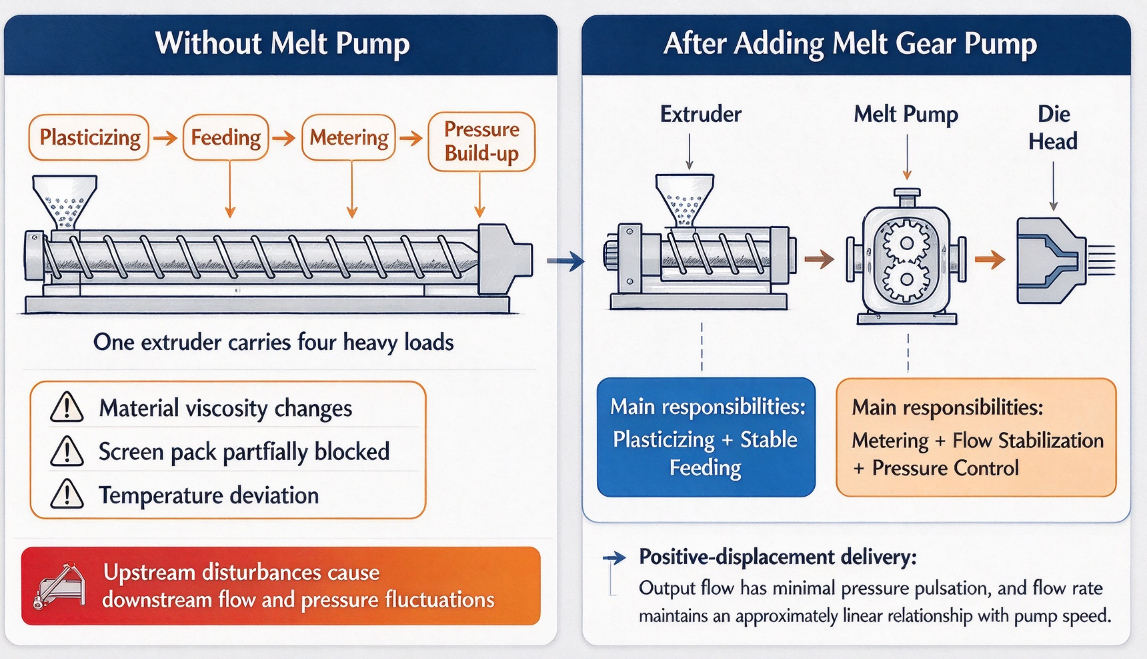
Traditional plastic extrusion lines place four heavy responsibilities onto a single extruder: plasticizing, feeding, metering and pressure build-up. The extruder screw must finish all tasks at once. However, small disturbances in production will directly cause fluctuations in downstream melt flow and pressure. Even slight changes in material viscosity, partial screen blockage or minor temperature deviation can compromise product uniformity, resulting in inconsistent thickness and high reject rates.
Installing a melt gear pump between the extruder and die head solves this core problem by splitting the workload. The extruder is now only responsible for plasticizing resin and stable feeding. The melt gear pump takes over metering, flow stabilization and pressure regulation. This functional separation transforms production from “one machine handling everything” to “divided tasks between plasticizing and metering”.
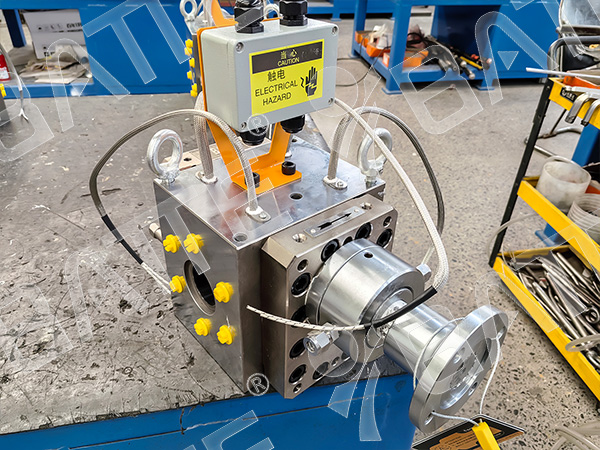
As a positive-displacement delivery device, the melt gear pump delivers melt through meshing gears. Its output flow has minimal pressure pulsation, and the flow rate maintains an approximately linear relationship with pump rotation speed. It effectively isolates upstream fluctuations and sends steady, consistent polymer melt to the die.
This upgrade brings tangible benefits for thermoplastic processing. The extruder screw bears less backpressure, lowering equipment wear and energy consumption. Shorter polymer residence time reduces thermal degradation of sensitive plastics. The system is easy to integrate with screen changers and PLC control systems, suitable for film, sheet, pipe and pelletizing extrusion.
For plastic manufacturers struggling with unstable extrusion, the melt pump is a practical retrofit solution. It stabilizes melt conditions, cuts scrap rates and raises finished product quality, becoming a vital auxiliary component in precision thermoplastic extrusion.
Email: sale@meltpump.com
WhatsApp: +86 158 3833 1071
pre:How can melt pumps empower POE underwater cutting and granulation to stabilize particle quality?
next: None


 TEL:+86 371 67991755
 WhatsApp: +86 158 38331071

 Adress: No.22 Dongqing Str., High & New Technology Development Zone, Zhengzhou, China.

