In the precision extrusion process of plastic sheets, the melt pump has become a key equipment for improving product quality and production efficiency due to its unique technical advantages and mechanism of action.
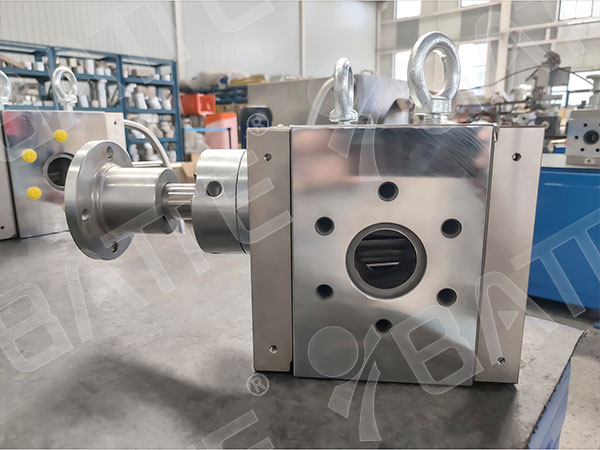
1. Stable melt pressure and flow rate to ensure precision extrusion
Pressure fluctuation suppression: The melt pump can buffer the pressure pulsation caused by factors such as screw speed fluctuations and temperature changes in the extruder through the volumetric conveying principle of gear meshing, ensuring that the melt enters the die at a constant pressure.
Accurate flow control: The output flow rate of the melt pump is linearly related to the rotational speed. By adjusting the pump speed, the melt flow rate can be precisely controlled to meet the requirements of sheet thickness uniformity (thickness tolerance can be controlled within ± 1%), significantly reducing the scrap rate.
Application scenario: In fields such as optical grade PET sheets and high barrier packaging films that require extremely high thickness consistency, the stable pressure and flow characteristics of the melt pump can avoid surface flow marks and uneven thickness caused by pressure fluctuations.
2. Improve melt quality and optimize sheet performance
Melt homogenization: the shearing and mixing action of the gear inside the melt pump can eliminate the "dead zone" residues in the melt, promote the dispersion of additives, reduce defects such as gel and crystal point, and improve the surface smoothness and transparency of the sheet.
Thermal stability: By optimizing the flow channel design and heating system, the melt pump can accurately control the melt temperature (fluctuation range ≤± 1 ℃), avoiding fluctuations in sheet properties caused by uneven temperature (such as inconsistent shrinkage and decreased mechanical properties).
Typical case: In the production of medical grade PVC sheets, the homogenization function of the melt pump can ensure uniform distribution of plasticizers, avoiding brittleness or precipitation problems caused by local differences in plasticizer concentration.
3. Reduce extruder load and extend equipment lifespan
Pressure reducing and stabilizing function: The melt pump undertakes the pressure building task at the end of the extruder, allowing the extruder screw to operate at lower pressures, reducing wear between the screw and the barrel, and extending the service life of the equipment.
Energy consumption optimization: The efficient conveying capacity of the melt pump can reduce the load on the extruder motor, and the comprehensive energy consumption can be reduced by 15% to 30%, while reducing the risk of melt degradation caused by high temperature and high pressure.
Process stability: By reducing the back pressure of the extruder, the melt pump can reduce the residence time of the melt in the barrel, avoiding performance degradation caused by a long thermal history of the material, especially suitable for the processing of heat sensitive materials such as PC and PMMA.
4. Expand the process window and adapt to diverse needs
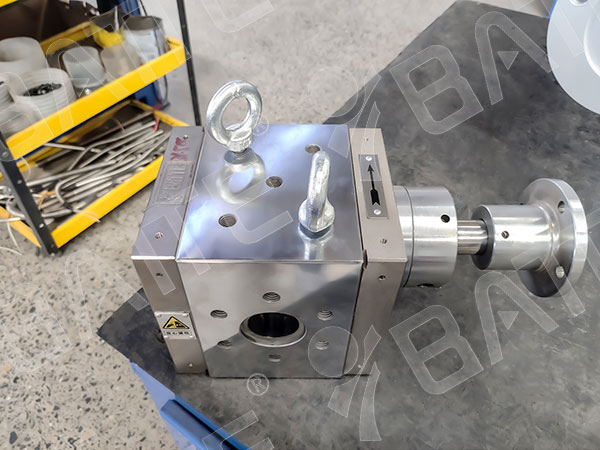
High viscosity material processing: The melt pump can provide an output pressure of up to 40MPa, easily conveying high viscosity melts (such as PEEK, LCP and other engineering plastics), breaking through the viscosity limitations of traditional extruders.
Multi layer co extrusion compatibility: In the production of multi-layer co extruded sheets, the melt pump can independently control the flow rate and pressure of each layer of melt, ensuring the accuracy of interlayer bonding strength and thickness ratio, and meeting the requirements of high-performance composite materials.
Special process support: The melt pump can be linked with online thickness gauges and closed-loop control systems to achieve real-time feedback and adjustment of sheet thickness, suitable for high-end processes such as micro foaming sheets and high barrier coatings.
5. Modular design, flexible integration and maintenance
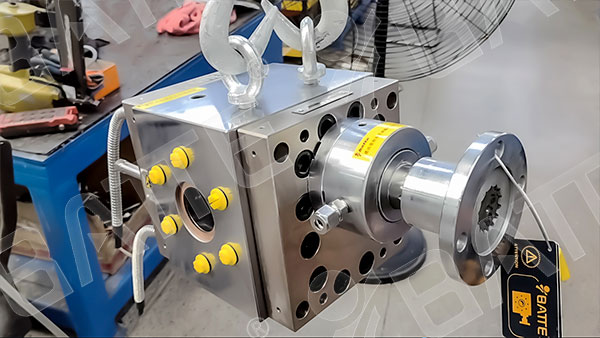
Compact structure: The melt pump adopts a short channel and low shear design, with a compact size that can be easily integrated into existing extrusion production lines without the need for large-scale modifications.
Maintainability: Modular gear sets and sealing structures facilitate quick disassembly and replacement, reducing downtime for maintenance; Some high-end models support online cleaning (CIP) function, further improving production efficiency
Extended functions: Optional accessories such as heating/cooling jackets, pressure sensors, flow meters, etc. can be selected to achieve full process monitoring and data traceability of melt temperature, pressure, and flow rate.
Email: sale@meltpump.com
WhatsApp: +86 158 3833 1071
pre:How to install the reactor melt pump?
next: None


 TEL:+86 371 67991755
 WhatsApp: +86 158 38331071
 Adress: No.22 Dongqing Str., High & New Technology Development Zone, Zhengzhou, China.
